
Beschrijving
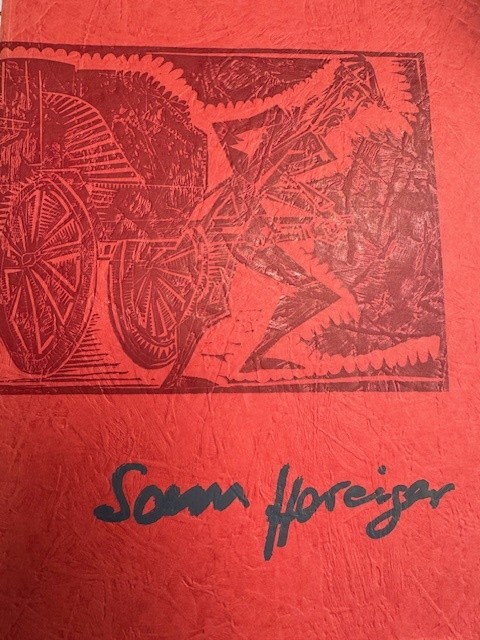
Antwerpen, W. Dillen, 1973, collection of 37 linogravuren (linocuts or engravings) made by Sam Herciger. Maijn Sjtetel (12 lino engravings) made to honour the 90th birthday of Prof. Dr. Nico Gunzburg in 1972, with reproduction of a letter by Gunzburg to Herciger, 12 further lino engravings called Jewish Feasts and 13 lino engravings called Planet Auschwitz. With introductory text, list of exhibitions, bibliography and comes with two original exhibition brochures with a lino engraving as published for Hilversum 1974. Original softcover binding, block loosening. All plates are present. Sam Herciger was born in Poland in 1917 in Zawiercie and died in Arad in 1981 in Israel. He was a sculptor and engraver of Jewish origin. He had four siblings and was raised in an Orthodox house; he studied in a ‘cheder’, but practiced painting. At the age of 16, he left Orthodox life and the family home. He started working in fur processing. He crossed the border into the Soviet Union, hoping to study art and music, but was arrested there accused for spying and sent to prison where he learned Russian. After his release, he returned to Poland, where he was arrested once again on suspicion of now being a Soviet spy. Released again, he decides to travel to Belgium, where he finally settles in Antwerp. He rediscovered his love for art and began studying at the Antwerp academy. He was a pupil from 1937 on in the class led by the sculpture Willy Kreitz.After the outbreak of World War II, Herciger attempted to flee to Spain but was arrested in France and interned in the Gurs camp. He was returned to Belgium by the French and despite the precarious situation in Antwerp he married a Jewish woman named Henni. A year later they both fled to France an attempt was made to live hidden but they were captured and deported to Auschwitz, where Henni perished in the womens camp, while Sam was working in the camp laundry. In January 1945, the Soviet troops approach and the Nazis abandon the camp of Auschwitz, Sam Herciger among 57,000 other detainees were forced to march towards Germany. Weakened and sick they were sent in to this death march which he barely survived; 37,000 others were less fortunate.After the liberation, returning alive from hell, he moved to Brussels and continued his training at the Academy of Brussels with master sculptors like Marnix dHaveloose and Fernand Debonnaire. Texts in Dutch English and French. Foreword by Theo Vonck. Judaica. Scarce.