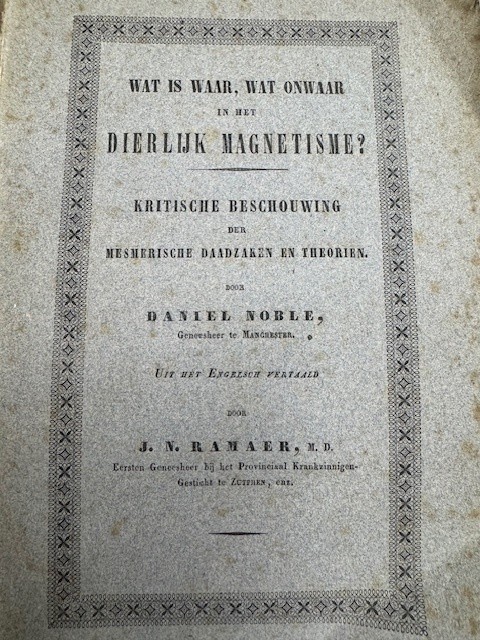
NOBLE, D., Wat is waar, wat onwaar in het dierlijk magnetisme? : kritische beschouwing der mesmerische daadzaken en theorien / door Daniel Noble ; uit het Engelsch vert. door J.N. Ramaer
€100,00
l
This took its name from the experiments of the Austrian physician Franz Mesmer in the 1770s, whose theory of animal magnetism was based on the belief that the human body possessed an invisible fluid that was affected by the planets. While his ability to induce a trance-like state in many of his subjects was not denied, his use of magnets to treat illness by influencing the flow of this fluid was derided by other physicians, and he moved his practice from Vienna to Paris. There, as widely reported in the British press, a commission established by Louis XVI in 1784 conducted a series of experiments before dismissing his methods as a threat not only to health… but also to morality, especially in the case of weak, virtuous women. Nevertheless, animal magnetism remained in the public eye in Britain, in the form of letters to newspapers urging closer examination of its therapeutic potential, demonstrations conducted by itinerant professors, or its mocking inclusion in theatrical performances such as the comic opera The Highland Reel in Canterbury in 1789, which incorporated the Farce of ANIMAL MAGNETISM (Kentish Gazette, 21 August 1789).
Op voorraad